Every live channel online starts with an encoder, the device or software that turns a video signal into a stream that can travel over the internet. If you run a channel, a hotel TV system or a school broadcast, this is the first piece of equipment to understand. Viewers never need one.
What an IPTV encoder does
It takes video from a camera, a satellite receiver or another source, compresses it and packages it for delivery. Without compression the stream would be far too large for ordinary connections.
HDMI and SDI encoders
- HDMI encoders take a consumer signal, such as from a set-top box or a camera. They are cheaper and easy to use.
- SDI encoders take the professional signal used in studios and broadcast trucks, with longer cable runs.
Codecs: H.264 or H.265
H.264 plays almost everywhere. H.265 (HEVC) needs about half the bandwidth for similar quality, but not every old device can play it. Many broadcasters use both.
Streaming protocols
| Protocol | Typical use |
|---|---|
| HLS | Delivery to browsers and apps, with adaptive quality |
| MPEG-TS | Classic transport inside IPTV systems |
| RTMP | Sending a stream to a platform |
| SRT | Reliable contribution over unstable networks |
Types of encoders
- Single-channel boxes for one input.
- Multi-channel units for several channels at once.
- 4K encoders for high resolution.
- Transcoders that convert one format into others.
- Software encoders that run on a computer.
Hardware or software?
Hardware is stable and runs for months without attention. Software is flexible and cheap to start but depends on the computer.
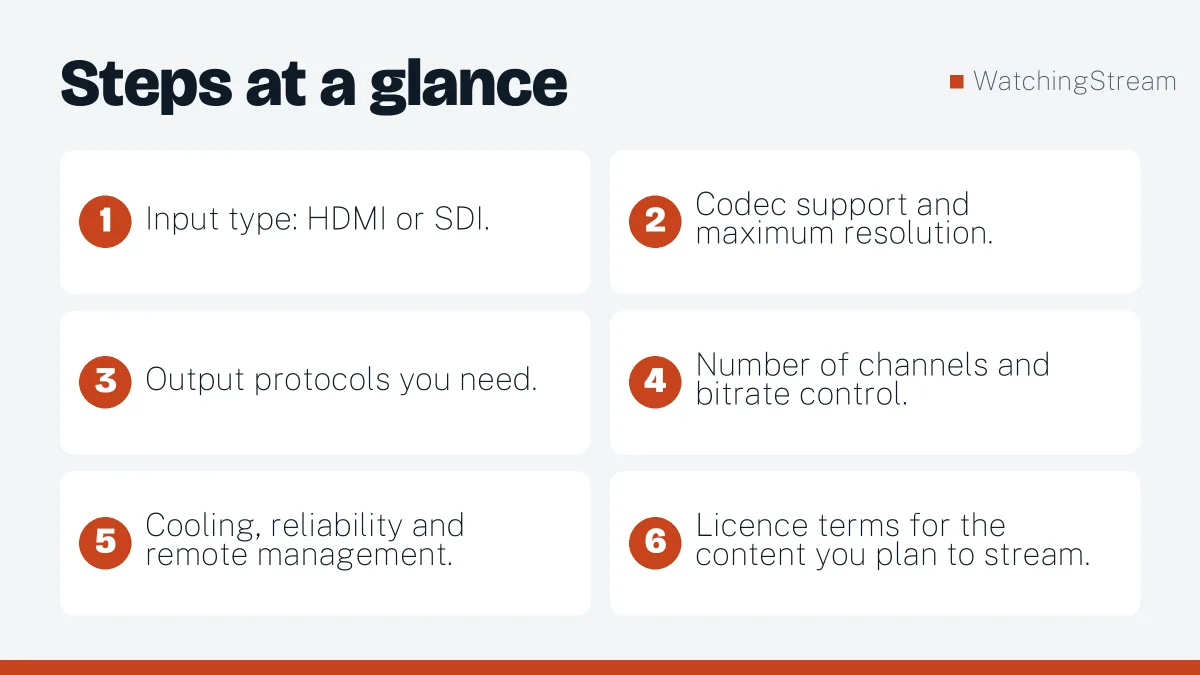
What to check before buying
- Input type: HDMI or SDI.
- Codec support and maximum resolution.
- Output protocols you need.
- Number of channels and bitrate control.
- Cooling, reliability and remote management.
- Licence terms for the content you plan to stream.
Where it fits in the bigger picture
The encoder feeds a streaming server, which delivers to players. Trends like better codecs are covered in the future of IPTV, and delivery quality depends on the viewer’s router and connection. Planning a service? See how to start an IPTV business. For viewer-side basics, read the types of IPTV. Mom IPTV also published its own encoder explainer.
Frequently asked questions
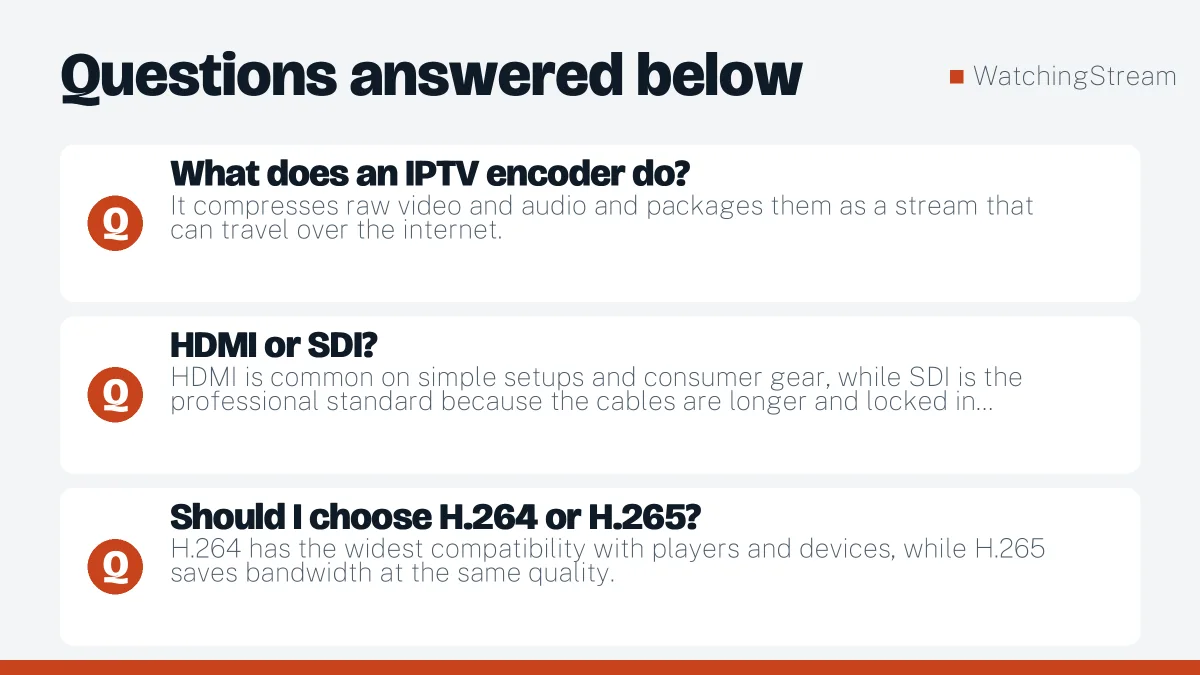
What does an IPTV encoder do?
It compresses raw video and audio and packages them as a stream that can travel over the internet. Without an encoder, a camera or a satellite receiver could not feed a live channel into an IP network. It sits on the sending side of the chain.
HDMI or SDI?
HDMI is common on simple setups and consumer gear, while SDI is the professional standard because the cables are longer and locked in place. Choose based on the equipment you already have.
Should I choose H.264 or H.265?
H.264 has the widest compatibility with players and devices, while H.265 saves bandwidth at the same quality. If your audience uses new TVs, H.265 is attractive. If they use older devices, stay with H.264. See the future of IPTV for AV1.
Do viewers need an encoder?
No. Only the party who sends the stream does. Viewers use a player app that decodes the video. If you only want to watch, read the setup guide instead.